
Introduction
Imagine running the same calculation in Excel twice. You get identical results every time. Now ask an AI the same question twice. You might get slightly different answers, both reasonable but not identical.
This isn’t a bug. It’s the fundamental difference between traditional software and AI.
For CTOs and architects making platform decisions in 2026, understanding this distinction isn’t academic. It shapes everything from architecture choices to risk models, from team structures to vendor evaluations. Traditional software excels at executing known rules with perfect consistency. AI excels at handling ambiguity, making judgment calls, and automating tasks that previously required human intuition.
The question isn’t which is better.
It’s knowing when each paradigm serves your business and how to combine them for maximum impact.
The Fundamental Difference: Deterministic vs. Probabilistic
Traditional software is deterministic.
Given the same input, it produces the exact same output every time. There’s no interpretation, nuance or variation. If your payment processing system calculates 100 × 1.18, it returns 118, not “approximately 118” or “118 with 95% confidence”.
AI systems are probabilistic.
They produce outputs that are probable, not guaranteed. Ask a large language model to summarize a document twice, and you’ll get two valid but different summaries.
This variability reflects how AI works: it’s learned patterns from data, not memorized explicit rules.
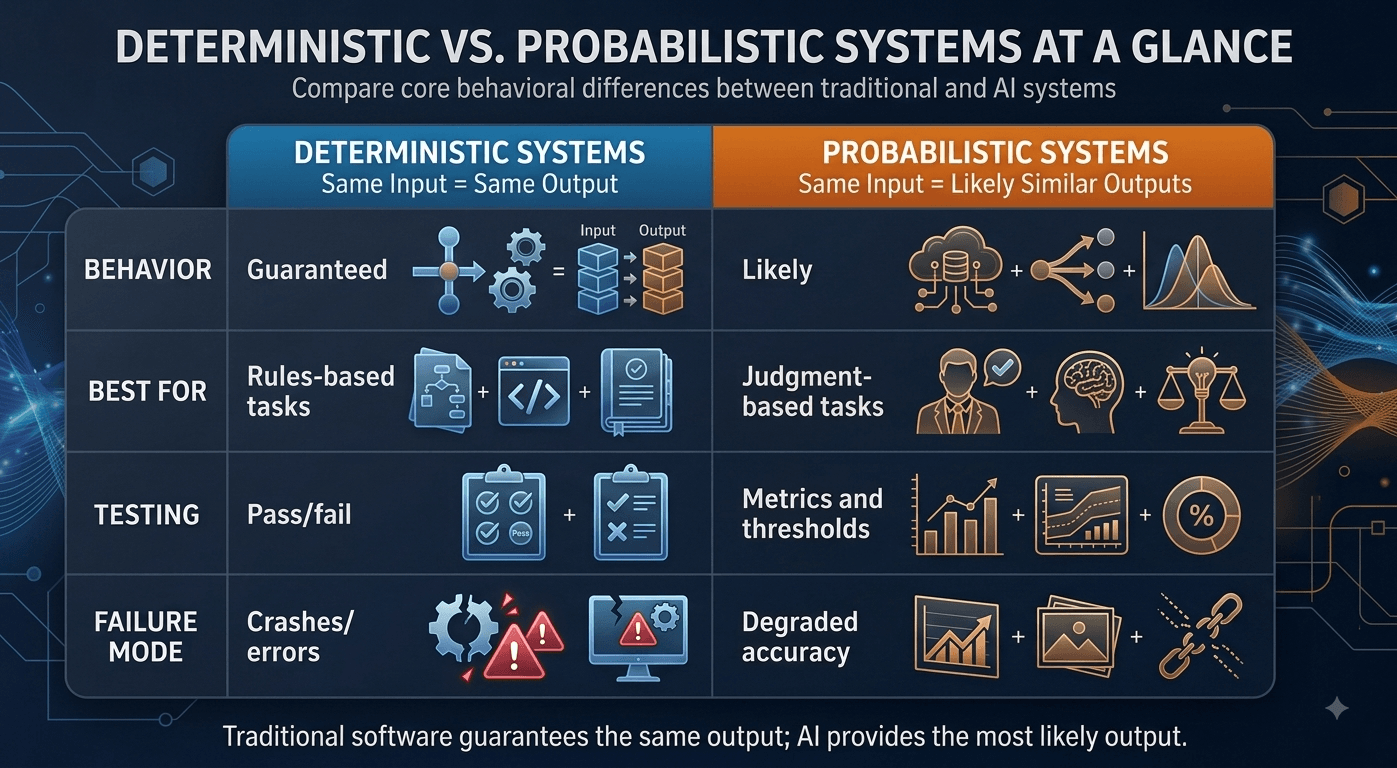
Deterministic vs. Probabilistic Systems at a Glance
Why Probabilistic Behavior Is a Feature, Not a Bug
For architects, this distinction matters because it determines what you can automate.
Deterministic systems handle tasks where rules are clear and outcomes must be exact: financial calculations, inventory tracking, authentication flows.
Probabilistic systems handle tasks where rules are fuzzy or impossible to fully document: customer support conversations, medical diagnosis assistance, fraud detection in novel patterns.
In healthcare, a deterministic system can calculate drug dosages precisely. An AI system can review patient history and suggest potential diagnoses a doctor should consider, not as a final answer, but as informed judgment. Both are valuable. Neither replaces the other.
How They’re Built: Rules vs. Patterns
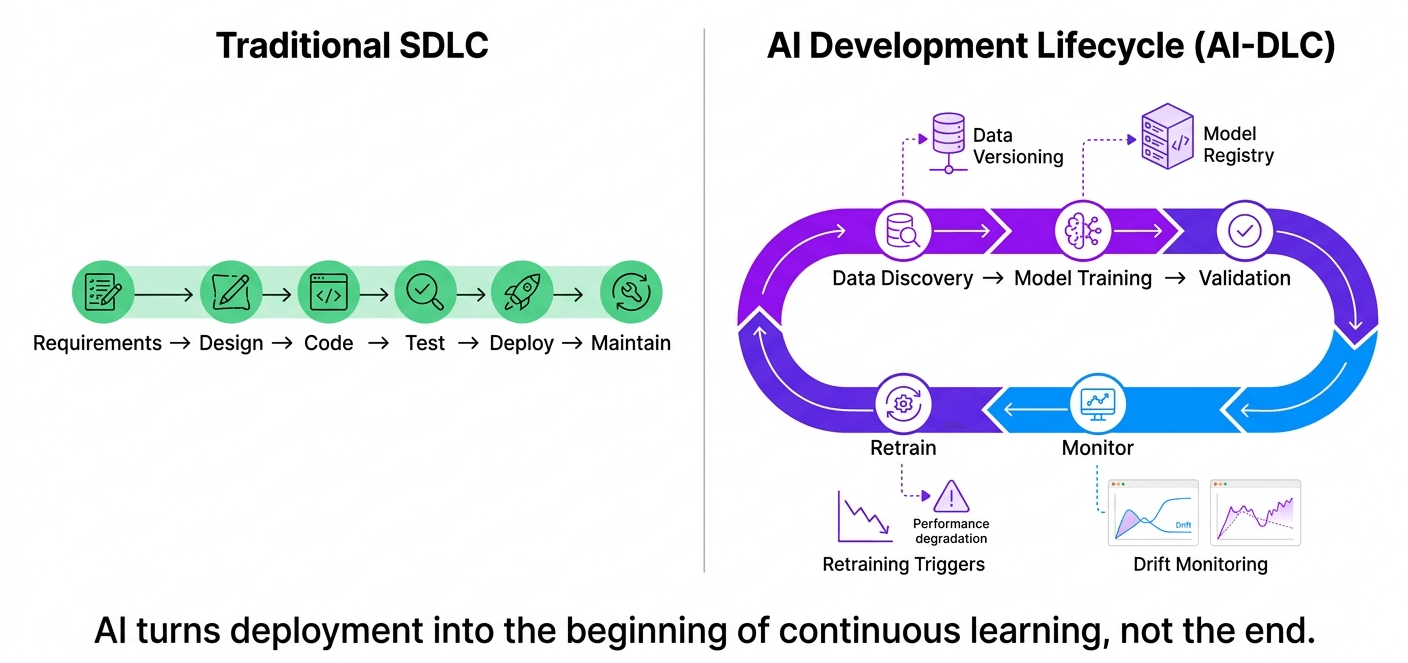
Traditional software development follows a linear path: gather requirements, design architecture, write code, test against specifications, deploy. Developers encode every rule explicitly. If a scenario isn’t covered by the code, the system either fails or behaves unexpectedly.
AI development is fundamentally different. Instead of writing rules, you curate data and train models. The “logic” emerges from patterns in the training data, not from if-then statements.
This shifts the development lifecycle from deterministic engineering to experimental discovery.
The AI Development Lifecycle (AI-DLC)
Unlike traditional SDLC, the AI-DLC includes:
- Data discovery and preparation: Identifying, cleaning, and labeling training data
- Model training and validation: Iteratively training models and evaluating performance on unseen data
- Deployment with monitoring: Launching with continuous drift detection and performance tracking
- Retraining pipelines: Automated or scheduled retraining as data distributions shift
Real-World Example: Fraud Detection in Finance
A traditional fraud detection system uses explicit rules: “Flag transactions over $10,000 from new accounts.” It’s transparent and auditable, but misses novel fraud patterns.
An AI-based system learns from historical fraud data to identify subtle, evolving patterns such as unusual timing, device fingerprints and behavioral anomalies. It’s less explainable but catches threats rules would miss.
For CTOs in finance, the choice isn’t binary. Many platforms now layer AI pattern detection on top of deterministic rule engines, combining the best of both worlds.
Testing and Validation: Pass/Fail vs. Metrics and Drift
Testing traditional software is straightforward: define expected outputs, run test cases, verify pass/fail. If the code produces the wrong result, it’s a bug. Fix it, redeploy, done.
Testing AI is more nuanced. You can’t test for exact outputs because the system is probabilistic. Instead, you validate:
- Accuracy: Does the model perform well on unseen data?
- Fairness: Are predictions unbiased across demographic groups?
- Robustness: Does performance hold under edge cases or adversarial inputs?
- Calibration: Do confidence scores reflect actual likelihood?
The Challenge of Model Drift
Unlike traditional software, AI systems degrade over time as real-world data shifts. A model trained on 2023 e-commerce behavior may underperform in 2026 as consumer patterns change. This requires continuous monitoring for data drift (input distributions shift) and concept drift (the relationship between inputs and outputs changes).
For architects, this means building observability into the AI layer from day one: logging predictions, tracking performance metrics, and setting up alerts for degradation.
Maintenance and Evolution: Bug Fixes vs. Retraining
Traditional software maintenance involves fixing bugs, patching vulnerabilities and adding features through code updates. The system is stable between releases. If it works today, it’ll work tomorrow unless something external changes.
AI maintenance is continuous. Models need regular retraining on fresh data. Performance must be monitored in production. Sometimes, a model that worked perfectly last quarter underperforms this quarter because the world changed. This isn’t a failure of the system; it’s the nature of learning from data.
MLOps: The New DevOps
This reality has given rise to MLOps, practices and tools for managing AI systems in production. Key components include:
- Model registries: Version control for trained models
- Automated retraining pipelines: Scheduled or trigger-based retraining
- A/B testing frameworks: Safely comparing new models against production baselines
- Drift detection: Real-time monitoring for data and concept drift
For CTOs, this means AI teams need different skills than traditional dev teams: data engineers, ML engineers, and specialists in model governance, not just backend developers.
When to Use Which: A Decision Framework
Choosing between AI and traditional software isn’t about technology preference. It’s about matching the tool to the problem. Here’s a framework for architects:
Favor Traditional Software When:
- Deterministic output is required: Financial calculations, compliance reporting, safety-critical systems
- Rules can be fully documented: Tax calculations, workflow automation with clear conditions
- Execution speed and consistency are the constraint: High-frequency trading, real-time control systems
Favor AI When:
- Output is inherently non-deterministic: Customer support, content generation, creative tasks
- Rules can’t be fully documented: Fraud detection, medical diagnosis assistance, sentiment analysis
- Analytical quality is the constraint: Pattern recognition in large datasets, predictive maintenance
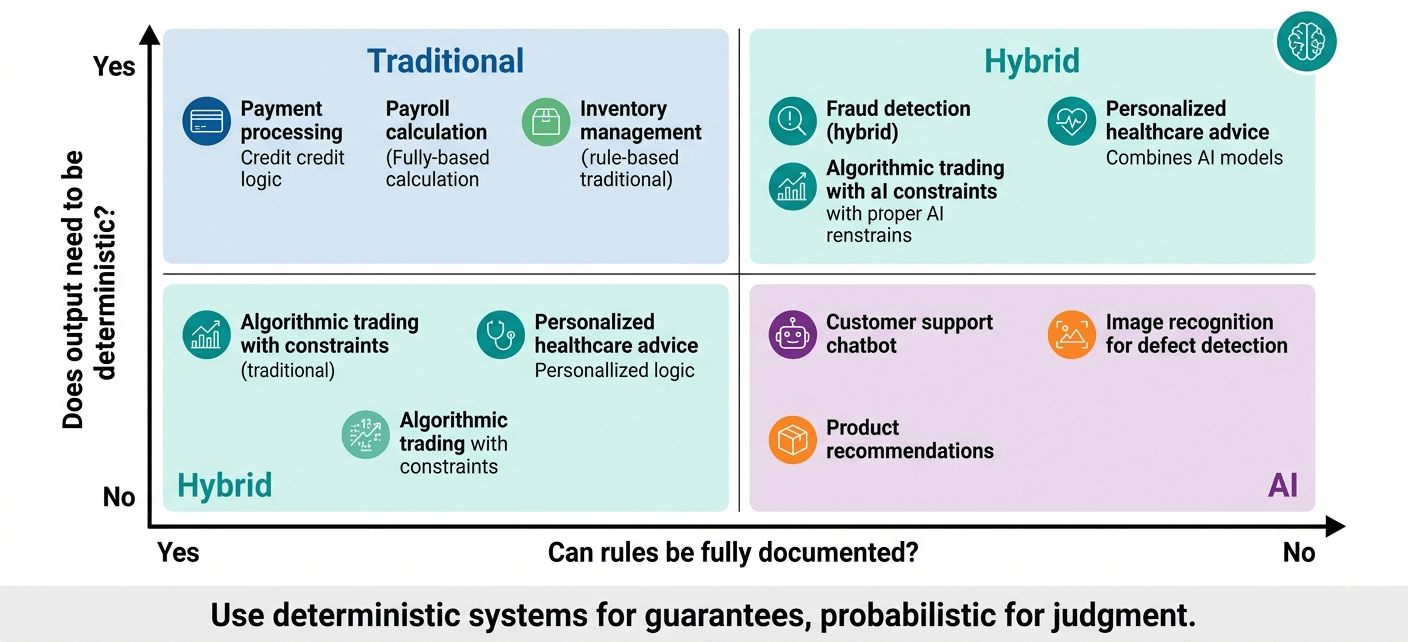
Decision Framework: When to Use AI vs. Traditional Software
Hybrid Systems: The Best of Both Worlds
The most powerful architectures in 2026 don’t choose between AI and traditional software. They combine them. Probabilistic reasoning handles ambiguity; deterministic guards ensure safety and compliance.
Pattern: AI + Validation Layer
Consider an AI agent that processes customer refund requests. The AI evaluates the request context, customer history, and policy guidelines to recommend a decision. A deterministic validation layer then checks:
- Is the refund amount within policy limits?
- Has this customer exceeded the maximum refunds per quarter?
- Does this require manager approval based on rules?
The AI handles judgment; the rules enforce boundaries. This pattern appears across domains:
- Healthcare: AI suggests diagnoses; deterministic checks validate against contraindications and dosage limits
- E-commerce: AI personalizes recommendations; rules ensure inventory availability and pricing constraints
- DevOps: AI predicts infrastructure issues; deterministic alerts trigger based on hard thresholds
Architecting Hybrid Systems
For CTOs designing these systems, key principles include:
- Clear separation of concerns: Keep AI reasoning and deterministic validation in distinct layers
- Explainability by design: Log AI recommendations alongside rule evaluations for audit trails
- Fallback mechanisms: If AI confidence is low, route to human review or deterministic defaults
- Continuous evaluation: Monitor both AI accuracy and rule coverage to identify gaps
This hybrid approach lets organizations capture AI’s transformative potential while maintaining the reliability and governance that enterprise systems demand.
Conclusion
The core mental model is simple: deterministic for guarantees, probabilistic for judgment. Traditional software will always excel at tasks where rules are clear and outcomes must be exact.
AI extends automation into domains where human-like reasoning, pattern recognition, and adaptability matter.
For CTOs and architects, the opportunity isn’t choosing one over the other. It’s understanding both paradigms deeply enough to architect systems that leverage each where it shines.
The most transformative platforms of the next decade won’t be purely AI or purely traditional. They’ll be hybrid systems that combine probabilistic intelligence with deterministic reliability.
The question for leaders isn’t whether to adopt AI. It’s how to integrate it thoughtfully into architectures that already work, extending what’s automatable without sacrificing the trust and consistency that users depend on.
How Quantaleap Can Help?
For CTOs and architects navigating the shift from deterministic to probabilistic systems, Quantaleap offers a strategic advantage as an AI-first technology consulting and services company headquartered in Silicon Valley.
Unlike traditional consultancies that retrofit AI onto legacy architectures, Quantaleap operates with a singular focus: to strategize, consult, and implement enterprise AI solutions that blend probabilistic intelligence with deterministic reliability.
Our approach directly addresses the hybrid systems pattern described in this article by deploying AI agents for judgment-based tasks, such as demand forecasting, fraud detection or customer service automation, while layering deterministic validation guards for compliance, safety and auditability.
Quantaleap's proprietary accelerator platforms, including Core360 for unified data intelligence and SC360 for supply chain optimization, turn fragmented enterprise data into the single source of truth that AI systems require to perform reliably in production.
Our capabilities span modern AI solutions, from GenAI and agentic AI to predictive analytics, integrated with enterprise platforms like Salesforce, ServiceNow, Oracle, SAP and Microsoft Dynamics. This ensures that AI initiatives align with existing governance frameworks and deliver measurable ROI.
For organizations ready to move beyond experimentation and architect AI-first enterprises that combine the best of both paradigms, Quantaleap provides the technical depth, proprietary accelerators, and global delivery model to execute at scale.