
Introduction: When AI Decisions Become Human Consequences
An artificial intelligence system can recommend a product in milliseconds. It can also rank a job applicant, summarize a medical record, approve a loan or guide a customer through a financial decision.
These actions may appear technical, but their consequences are deeply human.
The central question is no longer whether AI works. It is whether AI works fairly, safely, transparently and under meaningful human control.
AI ethics provides the principles that help society decide what systems should do.
Responsible AI turns those principles into engineering practices, governance processes and operational controls.
It connects abstract values such as fairness and dignity with concrete actions such as bias testing, access control, model monitoring and incident response.
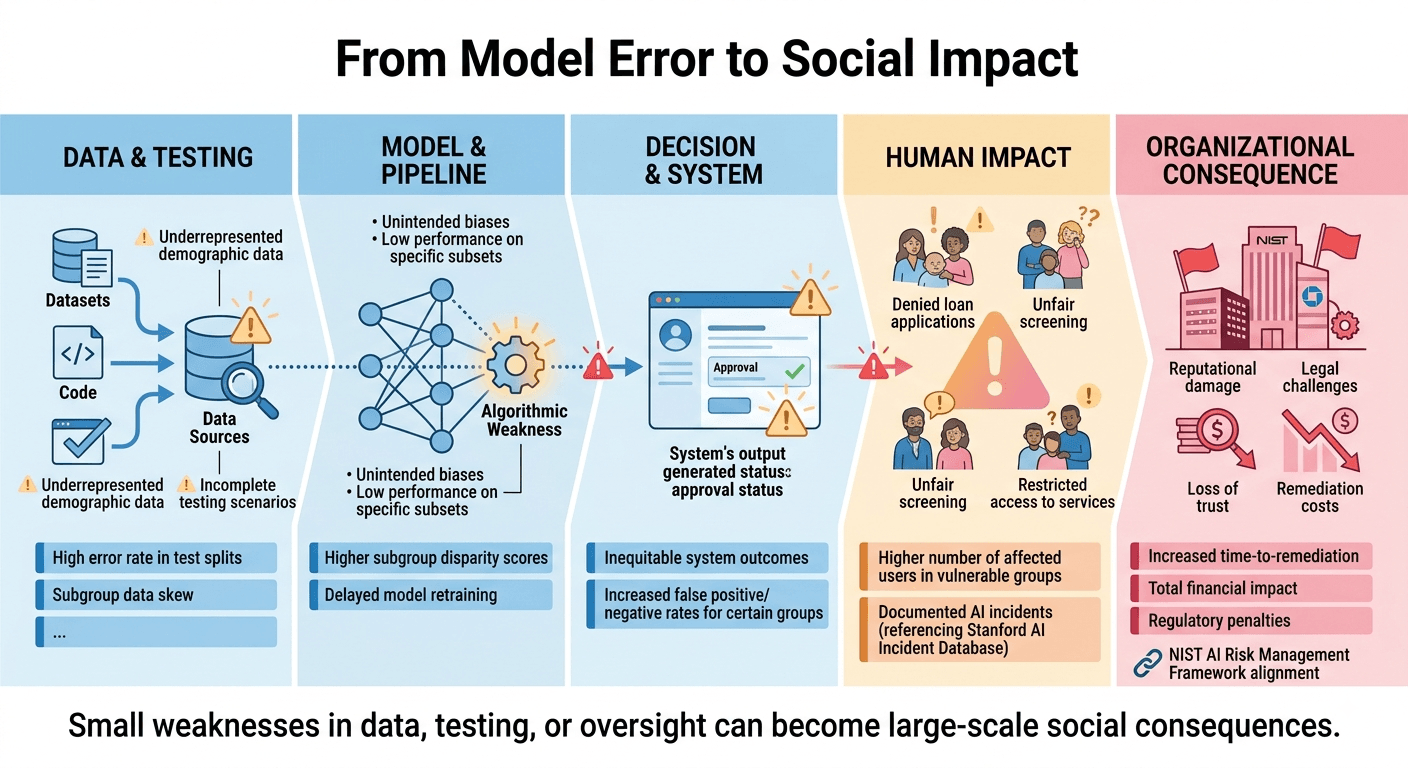
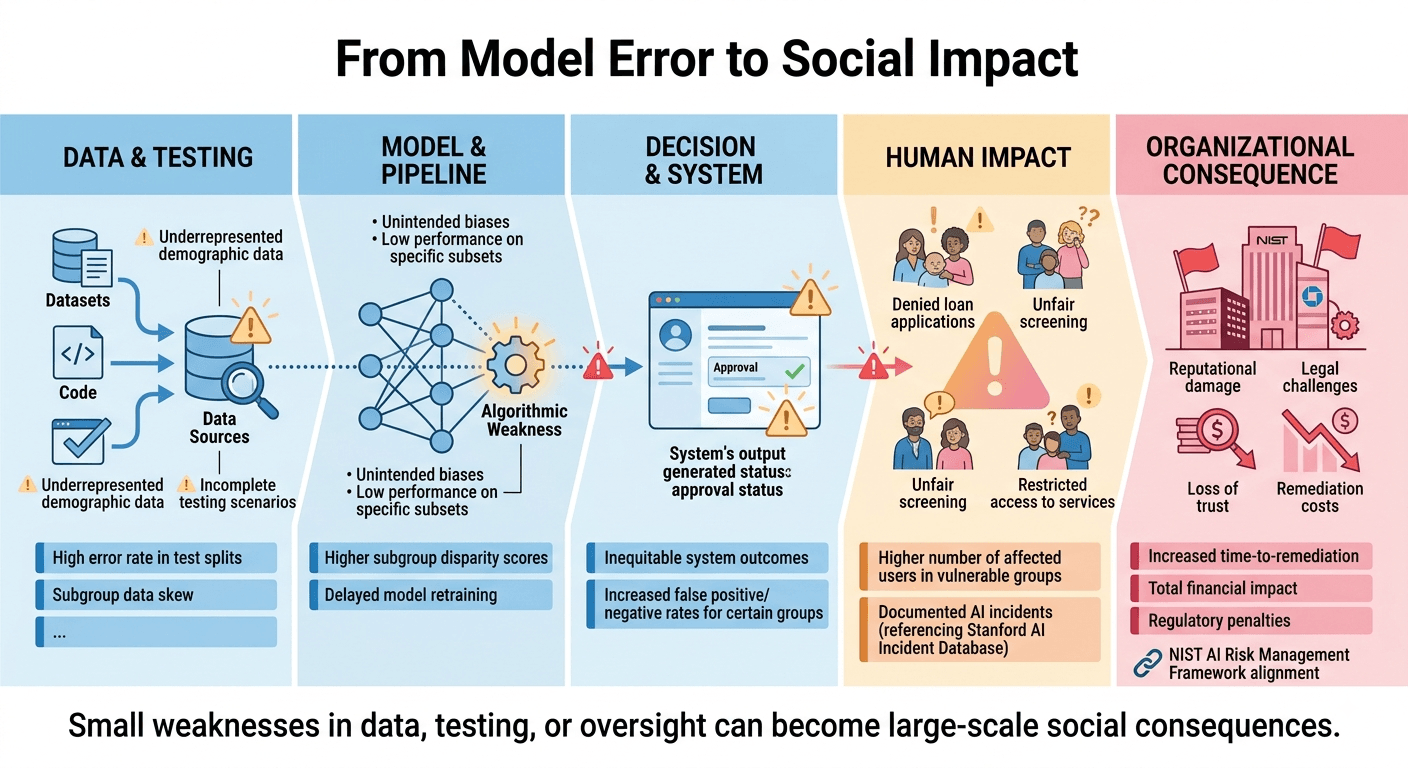
This matters because AI systems operate at extraordinary scale. A flawed manual decision may affect one person. A flawed automated system can repeat the same mistake thousands of times before anyone notices.
The Stanford AI Index reported 233 documented AI-related incidents in 2024, a 56.4% increase over 2023. [1]
For technology leaders, responsible AI is therefore not a public-relations exercise. It is a core requirement for building systems that deserve adoption.
AI Operates at Scale
AI systems learn patterns from data, optimize objectives and produce outputs that influence people or other systems. Each stage creates potential risks.
Training data may contain historical discrimination.
Labels may reflect inconsistent human judgments.
A model may perform well in aggregate while failing for a particular language, accent, age group or disability.
A deployment pipeline may then release that model without sufficient testing.
Generative AI introduces additional concerns. Models can fabricate information, expose sensitive data, reproduce copyrighted material or generate persuasive content at scale. NIST’s Generative AI Profile identifies risks including confabulation, data privacy, harmful bias, information integrity and cybersecurity. [2]
The important lesson is that responsible AI begins before deployment. It starts with defining the problem correctly.
If an organization asks an AI model to “maximize productivity,” the system may optimize for speed while ignoring employee wellbeing or service quality. If a lender asks a model to “minimize risk,” it may rely on historical signals that unfairly exclude certain communities.
Ethical design requires teams to examine not only whether a model meets its objective, but also whether the objective is legitimate.
Fairness and Inclusion
AI can reproduce bias because data reflects the societies that create it. Historical inequalities may appear in hiring records, credit histories, healthcare data, policing records or customer interactions. When a model learns these patterns without scrutiny, automation can make them look objective.
Fairness is not always a single mathematical target. Equal error rates across groups may conflict with equal predictive value. A system that is fair in one context may be inappropriate in another. Facial recognition, voice transcription, medical diagnosis and employee evaluation each require different definitions of acceptable performance.
Responsible teams should therefore use several safeguards:
- Test performance across relevant demographic and operational groups.
- Measure false positives, false negatives and confidence calibration.
- Review training data for missing or overrepresented populations.
- Establish appeal and correction mechanisms for affected users.
- Involve domain experts and impacted communities during system design.
- Monitor for performance drift after deployment.
This is especially important for voice-based AI. A speech system may appear accurate overall while misunderstanding regional accents, older speakers, children or people with speech disabilities. A small transcription error can become a serious problem when the system controls an appointment, a payment or an emergency workflow.
Fairness also requires humility.
Engineers should not assume that a technically elegant metric captures every social concern. Affected users must have a voice in deciding which harms matter and what remedies are acceptable.
Privacy and Human Dignity
AI systems are often data-hungry. They collect prompts, conversations, documents, images, audio, telemetry and behavioral signals. Even when a system does not store explicit sensitive information, it may infer health conditions, financial stress, political preferences or personal relationships.
Privacy risks appear in four stages: collection, inference, retention and reuse.
A voice assistant may retain recordings longer than users expect. An enterprise agent may expose confidential documents through an overly broad retrieval policy.
A model may infer sensitive characteristics from seemingly harmless data. A debugging log may quietly capture credentials or customer information.
Privacy-by-design reduces these risks through practical controls:
- Collect only the data required for the intended function.
- Limit retention and define deletion schedules.
- Encrypt data in transit and at rest.
- Separate customer data from evaluation and development environments.
- Apply role-based access and least-privilege permissions.
- Redact secrets and personally identifiable information from logs.
- Explain how data is used, stored and shared.
- Provide meaningful consent and correction options.
Privacy is not merely a compliance requirement. It protects autonomy. People should not lose control over their personal information simply because an organization can technically collect it.
This principle is particularly important for agentic systems with memory. Persistent memory can improve personalization, but it also creates a durable record of user behavior. Designers must decide what the system should remember, why it should remember it and how users can inspect or delete that memory.
Transparency and Accountability
People deserve to know when they are interacting with AI, especially when the system affects their rights, finances, employment, health or access to services.
Transparency does not mean publishing every model parameter.
It means providing enough information for users, operators, auditors and regulators to understand the system’s purpose, limitations, data boundaries and escalation paths.
Useful transparency mechanisms include:
- Model cards and system cards.
- Data and provenance documentation.
- Evaluation reports covering safety and subgroup performance.
- Audit logs for important decisions and tool calls.
- Clear labels for synthetic or AI-generated content.
- User notifications when humans review or override outputs.
- Public or internal incident-reporting procedures.
Accountability must remain with people and institutions. An algorithm cannot accept responsibility, explain a business decision or compensate someone who was harmed. The organization deploying the system must own those duties.
Human oversight must also be meaningful. A reviewer who can only approve every recommendation in seconds is not providing genuine oversight. Effective supervision requires sufficient authority, time, training, context and access to alternative information.
The European Union’s AI Act reflects this risk-based direction. Its implementation includes obligations concerning AI literacy, prohibited practices, general-purpose AI, transparency and high-risk systems, with major application milestones beginning in 2025 and continuing through 2027 under the current timeline. [4]
Responsible AI as an Advantage
Responsible AI is often presented as a constraint on innovation.
In practice, it can improve innovation by making systems more dependable.
Clear requirements improve product design. Strong evaluation catches defects earlier. Good observability makes production incidents easier to diagnose. Privacy controls reduce the risk of expensive data exposure. Documented ownership helps teams respond quickly when models fail.
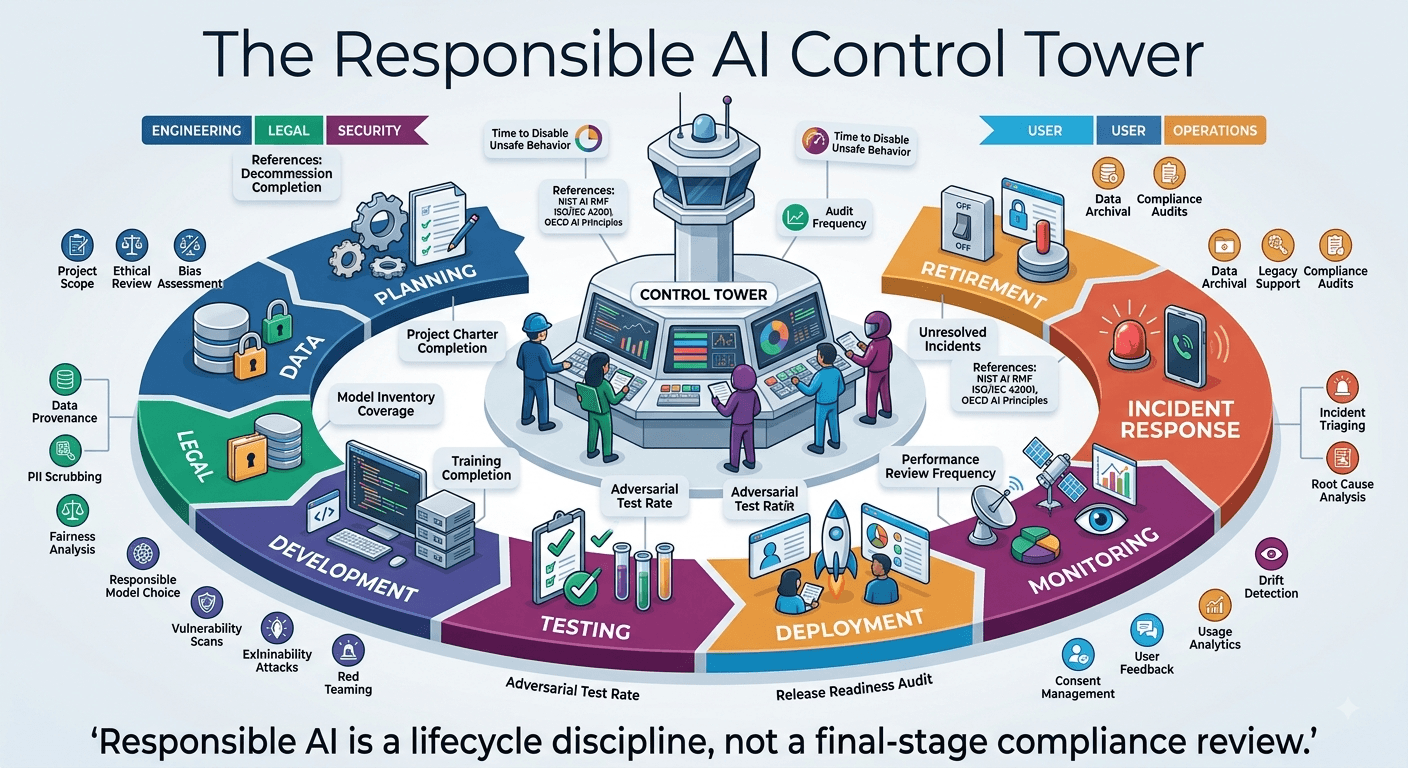
Responsible AI should become part of the engineering lifecycle:
- Create an inventory of AI systems, models, data sources and external providers.
- Classify each use case by potential impact and reversibility.
- Define measurable acceptance criteria before deployment.
- Test accuracy, safety, robustness, privacy and subgroup performance.
- Record limitations, assumptions and known failure modes.
- Monitor production outputs, user feedback, drift and incidents.
- Establish rollback, shutdown, escalation and remediation procedures.
- Reassess the system when its data, model, users or purpose changes.
For an enterprise voice agent, this might mean testing accents, background noise, interruptions and sensitive requests before launch. Production monitoring should track failed handoffs, unsafe completions, unexpected tool calls and user complaints. A kill switch should be tested before it is needed, not after a crisis begins.
The same discipline applies to large language model applications.
Retrieval boundaries, prompt-injection defenses, tool permissions, output validation and audit trails are ethical controls as much as they are security controls.
A system that can send emails, modify records or initiate payments should have narrower permissions than a system that only drafts text.
Conclusion
Ethics and responsible AI matter because AI systems increasingly shape opportunities, choices and outcomes. Their influence reaches beyond software interfaces into employment, finance, healthcare, education, security and public life.
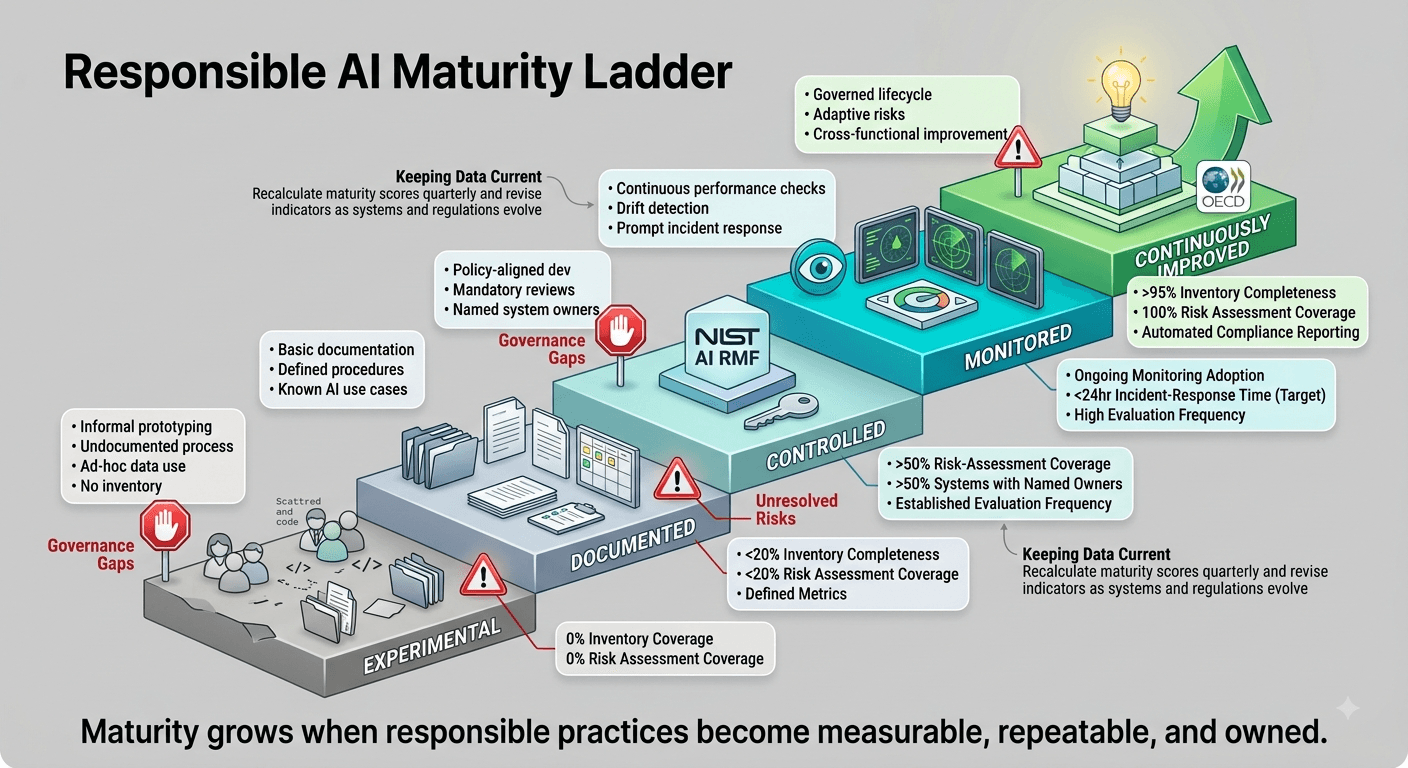
Trustworthy AI does not emerge from a single policy document. It emerges when values become architecture, tests, monitoring, governance and accountable decisions.
It requires engineers to question objectives, leaders to fund safeguards and organizations to listen to people affected by automated decisions.
The strongest AI systems of the future will not be judged only by accuracy or scale. They will be judged by whether people can understand them, challenge them and rely on them when the stakes are high.
Innovation earns lasting value when it is built with care, not merely speed.
How Quantaleap Can Help?
Quantaleap helps organizations turn responsible AI principles into practical, scalable systems by combining AI strategy, trusted data engineering, governance and continuous monitoring.
Our AI/ML enablement services support secure model deployment, data governance, access control and auditable operations, while platforms such as Core360 help unify fragmented enterprise data and provide contextual insights.
By embedding controls across the AI lifecycle, from data quality and privacy protection to model evaluation, observability and incident response, Quantaleap enables businesses to adopt generative and agentic AI with greater confidence.
This approach aligns innovation with accountability, helping organizations build AI solutions that are not only efficient and intelligent, but also ethical, transparent and worthy of user trust.
References
- Stanford Institute for Human-Centered Artificial Intelligence. “Responsible AI.” The 2025 AI Index Report, 2025. https://hai.stanford.edu/ai-index/2025-ai-index-report/responsible-ai
- National Institute of Standards and Technology. “Artificial Intelligence Risk Management Framework: Generative Artificial Intelligence Profile.” U.S. Department of Commerce, July 26, 2024. https://nvlpubs.nist.gov/nistpubs/ai/NIST.AI.600-1.pdf
- National Institute of Standards and Technology. “AI Risk Management Framework.” U.S. Department of Commerce, updated July 26, 2024. https://www.nist.gov/itl/ai-risk-management-framework
- European Commission AI Act Service Desk. “Timeline for the Implementation of the EU AI Act.” Updated 2026. https://ai-act-service-desk.ec.europa.eu/en/ai-act/timeline/timeline-implementation-eu-ai-act