
Introduction: The Great Misunderstanding About AI and Work
When a global bank rolled out generative AI for its customer support teams last year, managers braced for headcount cuts. Instead, something unexpected occured: agents handled 40% more complex cases, escalations dropped, and the team expanded to cover new premium tiers. This pattern is repeating across sectors, from software development to legal research.
Yet the narrative remains stuck on replacement.
The reality is more nuanced. AI won’t replace everyone, but it will change many jobs profoundly. Exposure is high, displacement is selective, and the net effect leans toward transformation rather than elimination.
For technical leaders and professionals navigating this shift, the question isn’t whether AI will affect your work. It’s how you’ll harness it to amplify human capability.
The Big Picture: Exposure ≠ Elimination
First, let’s clarify terms.
Exposure means a job’s tasks could be affected by AI, either through automation or augmentation.
Automation replaces human effort; augmentation enhances it.
Confusing these leads to unnecessary panic.
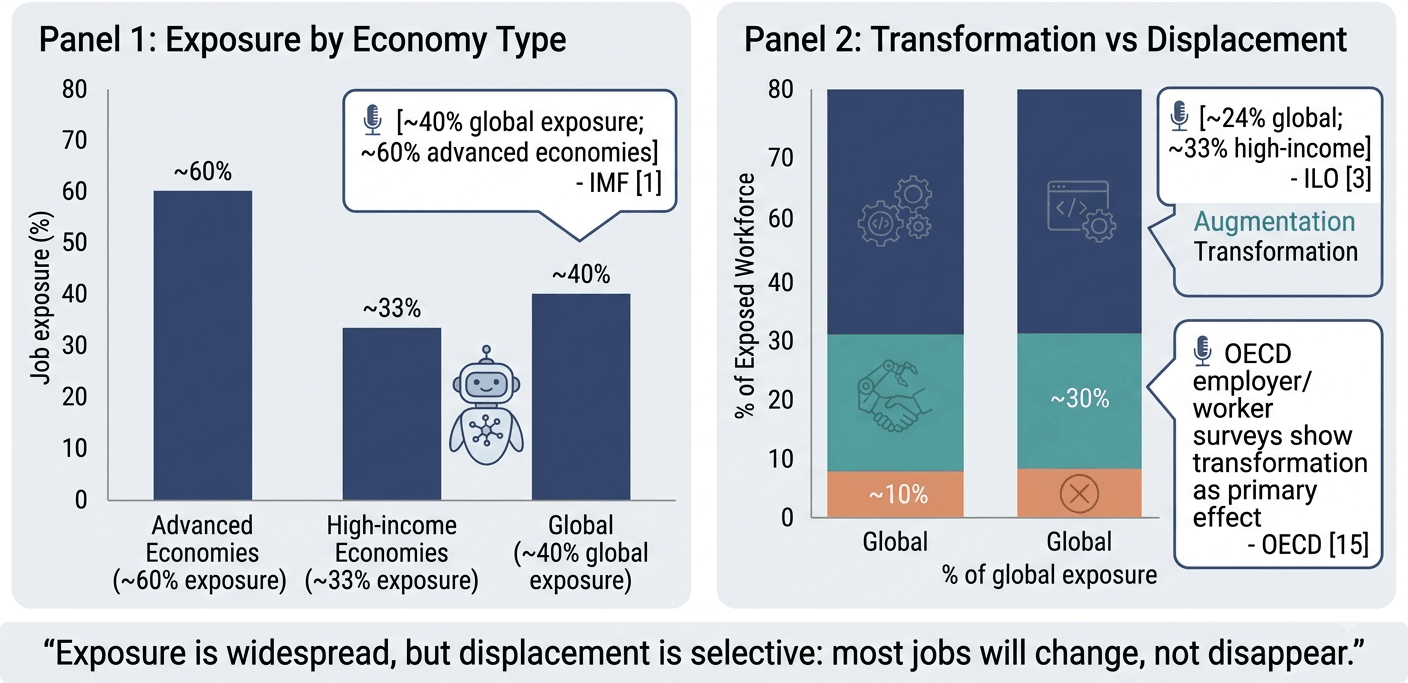
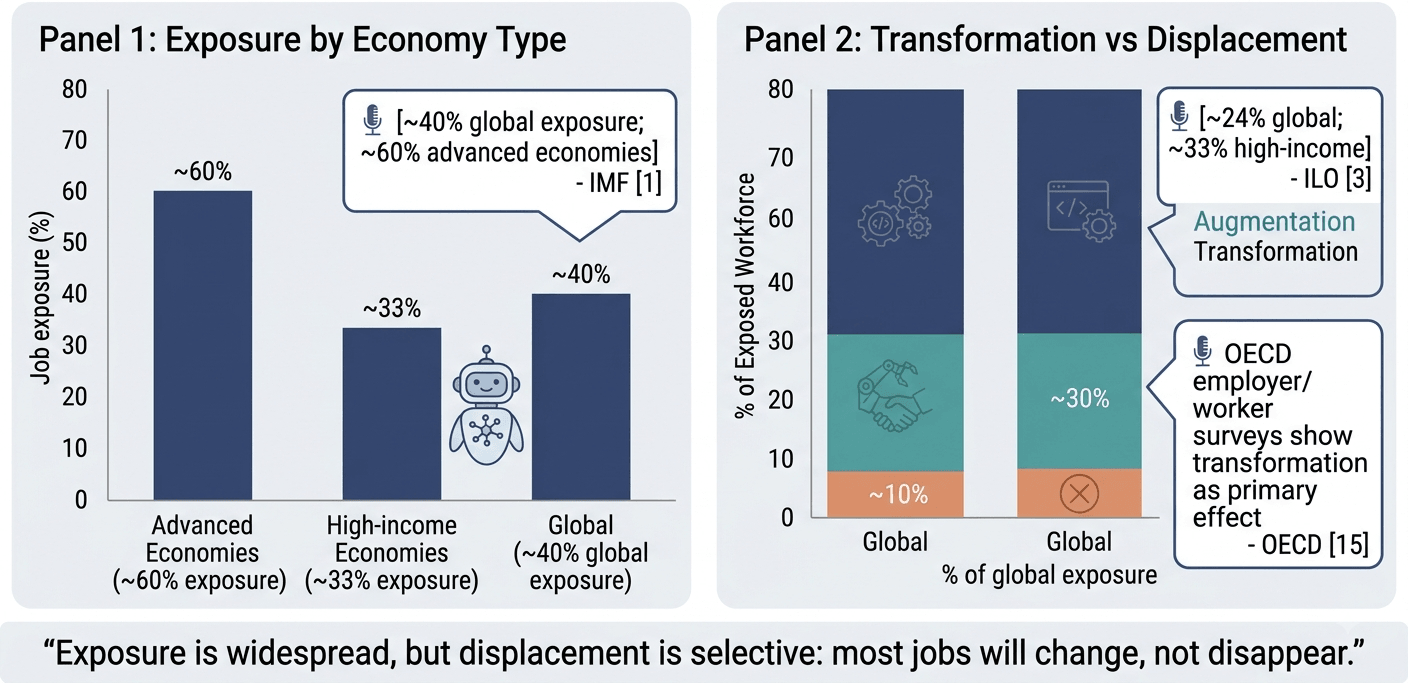
The numbers tell a clear story. The IMF estimates nearly 40% of global jobs are exposed to AI-driven change, rising to 60% in advanced economies. The ILO finds about one in four jobs (24%) globally show some degree of generative AI exposure, with one in three in high-income countries.
Yet exposure cuts both ways: some tasks get automated, others get upgraded, and many roles evolve into hybrid human-AI workflows.
Crucially, most work is transformed, not replaced. A 2025 Oxford Economics analysis of 1,200 enterprises across 14 industries found that companies deploying AI at scale saw net headcount increase by 4.2% over two years, versus 1.1% for non-adopters. This isn’t a temporary blip; it’s an early signal of an augmentation-led future.
Exposure vs. Displacement: What the Numbers Really Mean
Which Roles Are Most at Risk and Why
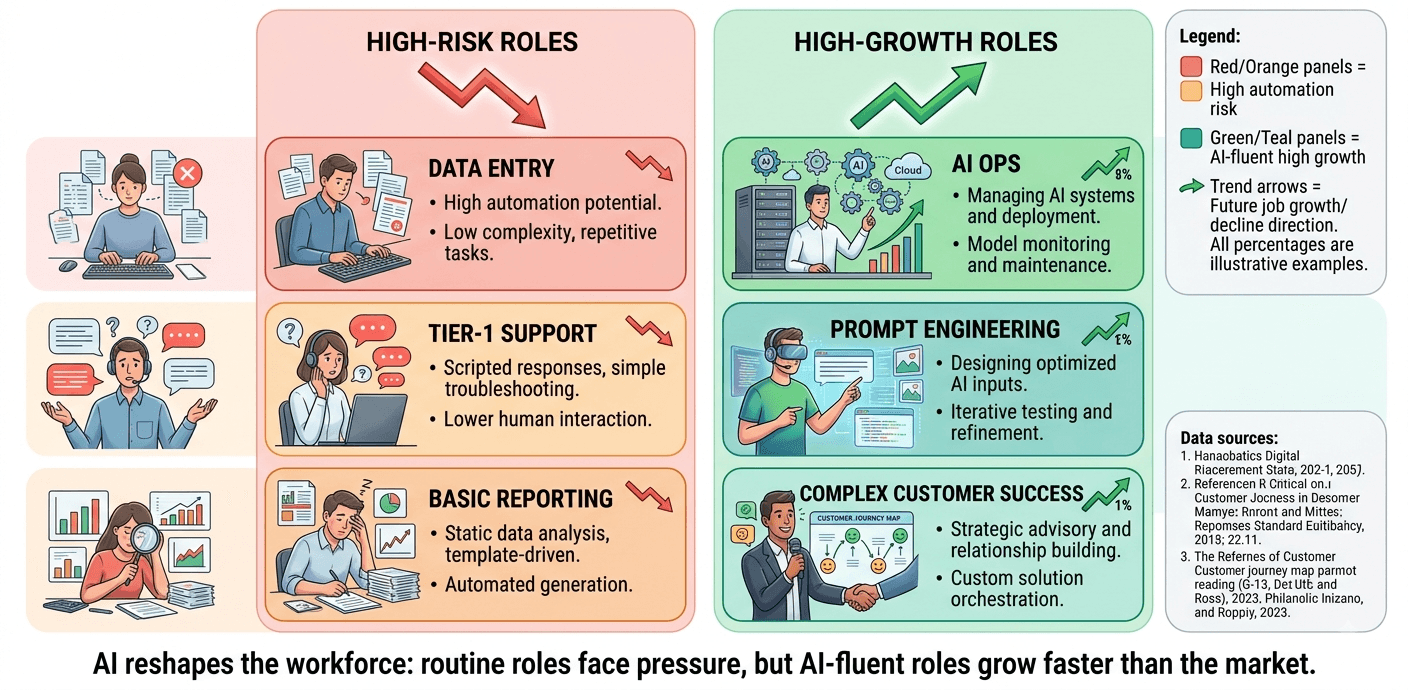
Not all jobs face equal pressure. Roles centered on routine, rule-based, structured cognitive work are most automatable. Think data entry, basic financial reporting, tier-1 support, inventory management, QA/checklist reviews and SQL-heavy reporting. These tasks have clear inputs, deterministic logic and measurable outputs, making them ideal for AI agents and copilots.
Sector patterns matter too. Administrative and legal services show higher exposure than interpersonal-heavy roles like nursing or skilled trades.
The ILO’s refined global index highlights that only 3.6% of jobs fall into the highest GenAI exposure category with elevated displacement risk, concentrated in specific occupations and regions.
Even within tech, entry-level roles in coding and analysis face more pressure than senior architecture or product strategy positions.
The mechanism is straightforward: AI excels at pattern recognition, language generation and structured reasoning at scale. When work is repetitive and well-defined, automation follows. But when tasks require negotiation, creativity or contextual judgment, humans remain indispensable even as AI handles the groundwork.
Where AI Creates and Expands Jobs
If some roles shrink, others grow, often faster. AI-driven job creation spans ML engineers, AI ops and prompt engineers, data scientists, customer success for complex escalations and AI-assisted sales roles. PwC’s 2026 AI Jobs Barometer reports that jobs requiring specific AI skills are growing 69% faster than the total jobs market (9%).
The augmentation dividend is real. Companies operating in the most AI-exposed sectors recorded 34% productivity growth in 2025 relative to 2018, compared to 24% for the least AI-exposed. The top 20% of AI-exposed firms achieved 163% productivity growth, nearly five times the average. This surplus capacity fuels expansion through new products, new markets and new responsibilities that didn’t exist before.
Daily GenAI users report tangible benefits: 92% say productivity increased (vs 58% for infrequent users), 58% report higher job security (vs 36%), and 52% saw salary gains (vs 32%). Far from a zero-sum game, AI adoption correlates with headcount growth, wage growth, and role expansion in firms that invest in reskilling.
High-Risk vs High-Growth Roles in the AI Era
The Skill Shift: What Becomes More Valuable
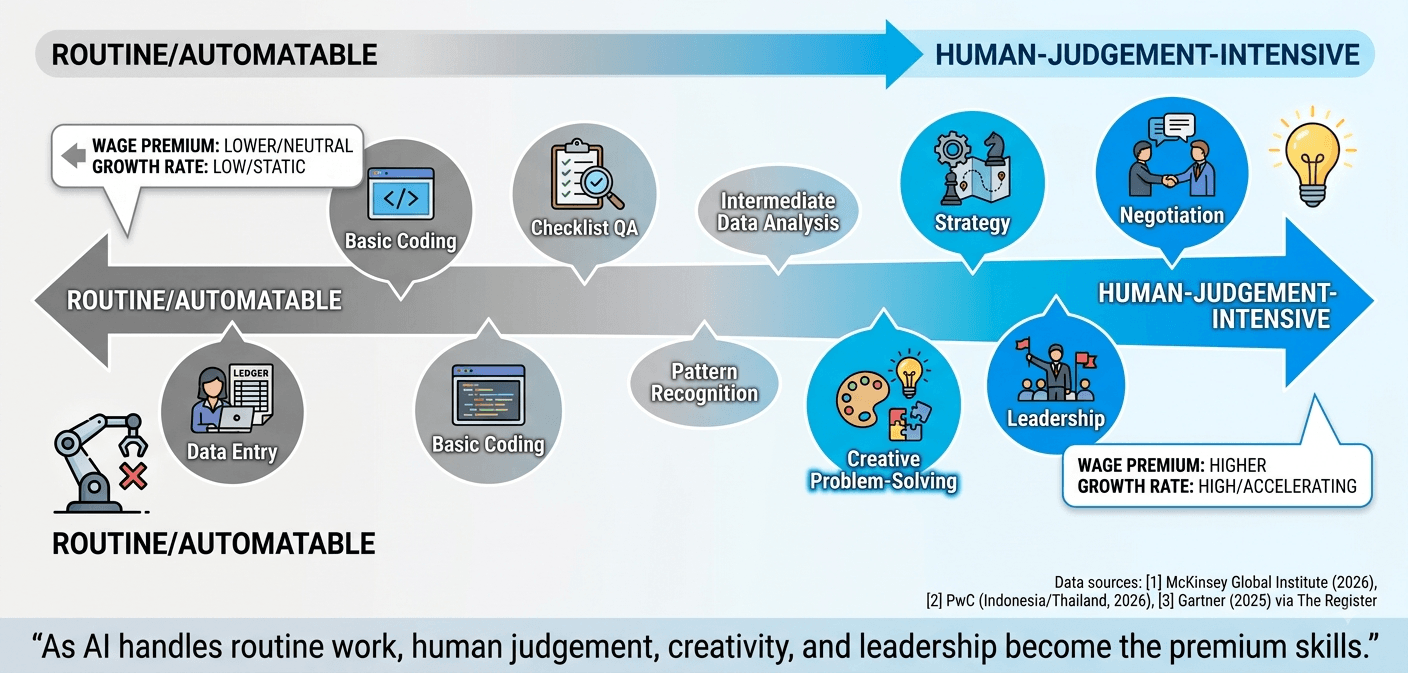
As AI absorbs routine tasks, human skills move up the value chain. McKinsey’s 2026 Skill Change Index shows AI won’t make most human skills obsolete; it will change how they’re used. Negotiation, problem-solving and leadership will matter more than ever as people work alongside agents and robots.
PwC’s research echoes this: the skills needed for the most AI-exposed jobs are changing more than twice as fast as those for the least exposed roles, a 75% increase over last year’s gap.
Employers increasingly emphasize judgement, creativity, and leadership, while routine technical tasks get automated or augmented. The wage premium for AI skills has surged to 62% in 2026, up from 57% in 2025 and 25% the year before.
This isn’t just about technical fluency. It’s about skill partnerships: humans defining problems, agents executing at scale and humans validating outcomes. Gartner predicts that by 2030, 100% of IT work will involve AI, 75% will be AI-augmented and millions of roles will be reshaped rather than replaced.
For technical leaders, the mandate is clear: redesign workflows around augmentation, invest in reskilling, and measure success by throughput and quality, not headcount.
The Skill Shift: From Routine Tasks to Human Judgement
Conclusion: Lead the Transition, Don’t Fear It
AI won’t replace everyone, but it will change many jobs, often for the better. Exposure is high, yet displacement remains selective.
The firms and professionals thriving in this era are those who treat AI as a force multiplier, not a threat.
For technical leaders, the path forward is clear: redesign workflows around augmentation, reskill teams for judgement-heavy work, and measure success by value created, not tasks completed.
For professionals, the opportunity is equally compelling: move up the value chain, embrace AI fluency and focus on irreplaceably human strengths such as negotiation, creativity and strategic thinking.
The future of work isn’t human versus machine. It’s humans working with machines, faster, smarter and more effectively than ever before.
How Quantaleap Can Help?
For enterprises navigating this transformation, partners like Quantaleap provide the strategic bridge between AI potential and workforce reality by focusing on three critical areas: workforce upskilling, right AI use case identification, and AI-driven workforce management to minimize attrition.
Our AI-Driven Workforce Enablement programs empower employees with AI assistants and innovation programs that enhance productivity while building internal AI fluency, directly aligning with the finding that 92% of daily GenAI users report productivity increases and 58% report higher job security.
Our Readiness & Use Case Discovery service identifies where Agentic AI can deliver the most value by assessing existing systems, data maturity, and integration feasibility, ensuring organizations automate routine tasks while augmenting high-value human work.
Perhaps most critically, Quantaleap leverages AI for predictive analytics on workforce signals, identifying patterns that forecast attrition risks before they materialize and triggering targeted interventions like manager touchpoints, recognition programs, and learning opportunities, especially valuable given that AI-exposed jobs are growing 69% faster than the market, yet organizations still face retention challenges during transitions.
The result is a transformation pathway that mirrors this article's core thesis: AI won't replace everyone, but organizations that invest strategically in workforce enablement, use case prioritization, and retention-focused AI deployment will thrive.
References
- IMF. “New Skills and AI Are Reshaping the Future of Work.” IMF Blog, January 14, 2026. https://www.imf.org/en/blogs/articles/2026/01/14/new-skills-and-ai-are-reshaping-the-future-of-work
- IMF. “Leveraging Artificial Intelligence and Enhancing Countries’ Preparedness.” IMF News, February 3, 2026. https://www.imf.org/en/news/articles/2026/02/03/sp-md-leveraging-artificial-intelligence-and-enhancing-countries-preparedness
- ILO. “Generative AI at work: What it means for jobs in Europe and beyond.” ILO Resource, September 29, 2025. https://www.ilo.org/resource/article/generative-ai-work-what-it-means-jobs-europe-and-beyond
- ILO. “AI may affect nearly 80 million workers in the ASEAN region, but large-scale job disruption not yet seen.” ILO News, July 8, 2026. https://www.ilo.org/resource/news/ai-may-affect-nearly-80-million-workers-asean-region-large-scale-job
- PwC. “AI reshapes global labour market into two distinct paths, rewarding human skills: PwC 2026 Global AI Jobs Barometer.” PwC Press Release, June 15, 2026. https://www.pwc.com/gx/en/news-room/press-releases/2026/pwc-2026-ai-jobs-barometer.html
- PwC. “AI Jobs Barometer.” PwC Indonesia, July 13, 2026. https://www.pwc.com/id/en/media-centre/press-release/2026/english/ai-jobs-barometer-en.html
- PwC. “AI reshapes global labour market into two distinct paths, rewarding human skills: PwC 2026 AI Jobs Barometer.” PwC Thailand, July 31, 2026. https://www.pwc.com/th/en/press-room/press-release/2026/press-release-31-07-26-en.html
- PwC. “Daily GenAI users see higher pay, job security and productivity.” PwC Press Release, November 12, 2025. https://www.pwc.com/gx/en/news-room/press-releases/2025/pwc-2025-global-workforce-survey.html
- PwC. “How AI is already reshaping the job market—for the better.” PwC Insights, August 20, 2025. https://www.pwc.com/gx/en/issues/c-suite-insights/the-leadership-agenda/AI-jobs-barometer.html
- McKinsey Global Institute. “Skills reset for the AI age.” McKinsey Featured Insights, March 3, 2026. https://www.mckinsey.com/featured-insights/charts/skills-reset-for-the-ai-age
- McKinsey Global Institute. “AI won’t make most human skills obsolete, but it will change how they’re used.” X (Twitter), January 20, 2026. https://x.com/McKinsey_MGI/status/2013583604123644142
- Gartner. “All IT work to involve AI by 2030, says Gartner.” The Register, September 8, 2025. https://www.theregister.com/software/2025/09/08/all-it-work-to-involve-ai-by-2030-says-gartner/383890
- Oxford Economics. “What the Workforce Data Actually Shows After Two Years of AI.” Rework Resources, April 14, 2026. https://resources.rework.com/news/ai-jobs-skills/ai-replace-vs-augment-workforce-data
- Anthropic. “Labor market impacts of AI: A new measure and early evidence.” Anthropic Research, March 5, 2026. https://www.anthropic.com/research/labor-market-impacts
- OECD. “The impact of AI on the workplace: Main findings from the OECD AI surveys of employers and workers.” OECD Publishing, March 27, 2023. https://www.oecd.org/en/publications/the-impact-of-ai-on-the-workplace-main-findings-from-the-oecd-ai-surveys-of-employers-and-workers_ea0a0fe1-en.html